Showing posts with label Art history. Show all posts

Be Your Own Critic: Andrea Fraser & Wanda Raimundi-Ortiz

Recently, I was reading an article in ARTnews about the burgeoning trend in art circles that has been described as "poking fun at art-world inequities." Carolina A. Miranda pointed to the practice as a potentially enlightening process for both the artist and viewer, and cited Joe Sola. Sola's philosophy is multidisciplinary and borrows heavily from film history in order to animate his own perspective as a working artist. Through video, drawing, performance--even stuntman antics--his work is one of the many in a larger pool of cage rattlers. What is the perceived cage? You guessed it--the high art realm, which includes galleries, critiques, and even the less formal studio visit.

It's been done before (about twentysomething years ago) by Andrea Fraser, the New York-based artist who famously humped the interior of a museum. It's not any more graceful than it sounds, and this is the intention--as Frieze's Melissa Gronlund aptly summarized her contribution to a more honest art dialogue:
Andrea Fraser’s performances add gender and sexual dimensions to the critique of art institutions carried out by Hans Haacke, Daniel Buren, Carl Andre and others. Fraser’s approach is usually to assume the role of a museum volunteer or invited artist and then shift her position during the course of her performance to one of keen critic.
Gronlund proceeded to mention that Fraser's writings about high art society is less than "heartening" (and isn't this what we seek when we seek art out?) but do not despair. This can indeed induce what I'd say are tough art historical times. I mean, is EVERYTHING about money? At these moments, it is achingly common to resent the facile nature of commodification and the fading promise of social mobility within such an enclosed, precious space.

But don't worry--the good news is that it's not a real space. It's imaginary. Yes, everyone, it's all in our minds, which is the reason that Conceptual Art came to be. By participating, and carrying your experience away from institutions (galleries, museums, universities), the exchange is distorted and ultimately enriched. Artists are becoming more brave by the second, and nothing is off limits for examination. For example, it wasn't always common to use horror films as inspiration for performance art.

The ARTnews article mentioned a remarkably funny and intelligent young artist, Wanda Raimundi-Ortiz. Her accessible version of an Art History lecture provides an additional version of a critical voice for the public. By means of a YouTube channel--a revolutionary step in inviting audiences to actively participate in creative dialogues--her character appears to be the stereotypical uneducated homegirl but quickly dismantles such a flimsy identity. Instead, she's the girl that might be sitting next to you in class or exhibiting at a gallery nearby. Watch this video, titled Critics.


Ellen Gallagher: An Ad for the Unspoken

Ellen Gallagher is an American-born, contemporary multimedia artist that speaks about our inner thoughts and the obscured details that push the less palatable down. Gallagher's works confront what we all eventually face: deep, nagging insecurity, broad and unknown danger around the corner, and disappointing interpersonal moments. A person's art work most certainly speaks about what they have decided to look at and, finally, let surface.

This past week, a humbling and insightful discussion led me to consider the process of repression. As an individual, what subject bothers me enough to work through it in visual form? Can I explain it? Does it have to wholly bother me or is there a space somewhere between curiosity and shame that elicits artistic response?

Gallagher's answer would be yes, and she would display her own self through her striking collaged imagery. The origins of Gallagher's works is highly accessible--they are what some might consider instructional "aids" to looking your best. Wig ads especially stand out to Gallagher, and she speaks about how she aims to "activate" characters in her painted, repeated figures. She also refers to our early imaginations of what it was to "be" a certain way, and how sometimes as adults, we (as artists and/or in our daily lives) can manage these recollections and create alternate narratives. Following are clips that exemplify her elegant and astute approach to visual culture.


I enjoy looking at a work of art that doesn't attempt to do it all at once--surely, the topic of sexuality, beauty, or race can overwhelm an artist with the best intentions. It can be rooted in the fear of being misread, too. Sometimes, when making art, a person can just hold back and work on something else that satiates their basic desire to speak but does not speak enough.

To relax, and to meditate upon the lines, the color, the balance--can be a calming exercise as good as a vibrant conversation. To view Gallagher's work is to acknowledge an artist's goal to examine an industry that was considered necessary and that required iconography of its own. Systems of iconography are created and recreated each day. What an important reminder for anyone who is unsure of where to begin in the seemingly endless maze that is the 21st century visual landscape. Perhaps it might help to just begin a conversation about these anxieties, and take it from there?

If you enjoy Gallagher, check out Kara Walker, whose bold silhouettes recreate the largely shameful history of the depiction of black women and men in American history. These two artists are just two of the many women who have sat down and considered the lack of sympathetic, realistic, and heroic imagery for women of color.

Recently, I began a list of stereotypes or hurtful images that I could recall about Mexican culture or Latinas. Immigration sprang up immediately, and was followed by the ever-present maid figure in pop culture. There was a lot to think about. I researched Latina artists working today, and could not find many at all--this is a space that also needs to be occupied and engaged by young or mature artists as well. Besides Ana Medieta, Isis Rodriguez, and Frida Kahlo, there is a similar lack of visibility for Latinas.

Again, acknowledgment and response sometimes feels like a tall order--and the fear of reinforcing negative stereotypes persists--but pushing these highly reflexive cultural details down would be a tragedy. Check out Walker's discussion about the occasional doubts in her own creative process:


If you are intrigued by Kara's work, read Seeing the Unspeakable: The Art of Kara Walker by Gwendolyn Dubois Shaw.

Gender Law + Women in 21st Century Art History

My Bed by Tracey Emin
My Bed
by Tracey Emin. Image via Wikipedia

I recently started working for the Alameda County Public Defender's Office, and it rules. The people are down-to-earth, the work is intellectually stimulating, and it's a diverse work environment--all of these qualities bear much value to me in other areas of life, including Art History. The last thing I want is to ignore underrepresented social groups or to encourage exclusivity to anyone that wants to voice their issues. Where do Art History and Law "meet"?

While I admire artists--many of them women who have enhanced Art History through the advancements presented in the 21st century understanding of art's contribution to society--I often wonder how easy it is to slip into a coded language that does not allow the public to "see" themselves. It's a problem that emerges in legal matters as well; legal practice is conditional upon the need to defend individuals/groups who do not have the resources or historical support that others do. In this way, it is always a two-sided process. Similarly, Art History provides viewers with an opportunity to adopt (or reject) a "case" for a subject.

I thought about this, and immediately considered the linguistic intersection that I became familiar with a few years back; it was a definition that brought the cultural enforcement of gender to my attention, in a way that I had not ever considered--gender law profoundly changed how I perceived life and art in general. In addition, the legal community has not overlooked the necessity for specific attention to inequalites that are created as a result of gender difference and stereotyping.

How do artists contend with this issue? Dina Felluga put it best when she related the social construct of gender to an established construction, which renders it unnatural:
Gender, according to Butler, is by no means tied to material bodily facts but is solely and completely a social construction, a fiction, one that, therefore, is open to change and contestation...Gender is, thus, a construction that regularly conceals its genesis" ("Performative" 273). That genesis is not corporeal but performative (see next module), so that the body becomes its gender only "through a series of acts which are renewed, revised, and consolidated through time" ("Performative" 274). By illustrating the artificial, conventional, and historical nature of gender construction, Butler attempts to critique the assumptions of normative heterosexuality: those punitive rules (social, familial, and legal) that force us to conform to hegemonic, heterosexual standards for identity.
Awhile back, I wrote about Tracey Emin's work, and her role as an artist whom challenges gendered understandings of everyday actions. I recently came across another article (via Art in America) that directly addressed how she examined gender through its art historical tropes. The article briefly noted a genre, Minimalism, which tends to be observed as "empty" in comparison to more readily obvious content that reads as masculine or feminine iconography. Ossian Ward noted that:
co-opted an industrial, masculine material generally associated with Minimal and Conceptual practitioners in America. Those neons hardly convey anything as specific as the bleeding-heart narrative of an oversexed, half-British, half-Turkish-Cypriot female artist from a small seaside town in southern England.
I don't know what to think about that last sentence. If you ever read Anna Chave's illuminating discussion, titled "Minimalism and the Rhetoric of Power," about the hypermasculine subtexts of Minimalist art, it's clear that there's a gendered reading happening in that analysis. Gender (art) law strikes again!

What do you think about this analysis? Emin herself is not averse to discussing her art in terms of sex but that is quite different from discussing her work in terms of gender. Would you say that she represents herself well as a female artist? Should she be considering gendered language? As you can see, she's a favorite of mine, and I think that she incites reactions that expose the complexity of Art History's fairly repressed depiction of women, gender, and sex. Please leave your thoughts below!

Gender Coding via Drag in Art History


Last weekend, I spent a night watching some of the most charismatic performances in the great city of San Francisco. It was a drag show at Aunt Charlie's, and the range of personas was an intriguing reminder about everyday performances. Thanks for that insight in grad school, Judith Butler -- the reality of gender as performance arises more often than I had imagined before learning about gender theory!

The first artist that springs to mind is Cindy Sherman, a celebrated American photographer who has maintained herself as both creator and subject in her large body of work. Here's one of the more well-known images, called Untitled (1981).

Detail Image
Image courtesy of Metro Pictures


Mirror, Mirror: On the Evolution of Women in Art History

This past week, my students explored the early to High Renaissance in class. We observed leaps and bounds in the role of the artist, the importance of humanism, and the innovations in formal techniques. Certain images kept popping up as signs of the times -- The Mona Lisa and the Arnolfini Wedding were most outstanding in terms of their reactions. Mona Lisa's daring eye contact and the presence of the mirror in the Arnolfini Wedding both pointed to a newfound reliance on the eye as a valued tool for understanding the world around us. During this period, man was the measure of all things, thanks to humanism.

Following are the famous images of mystery and enduring commitment:

Untitled, known in English as The Arnolfini Po...Arnolfini Wedding via Wikipedia

When students looked at these images, they marveled at the convincing illusionist techniques, and the absence of the artist in compositions. No one asked about the circumstances of the women in the paintings. Some found interesting articles about how da Vinci may have conceived his famous portrait from a self-portrait. Well, it's possible. And, it's not the first example of drag in Art History -- we can go back as far as ancient Egypt, when Queen Hatshepsut became pharoah. She took over the throne after the death of her pharoah husband Thutmose II, and donned the traditional masculine garb in accordance.

Google's Art Historical Turn: Art Project

I'm excited -- in addition to having access to countless databases, such as JSTOR, for online teaching purposes, Google has launched a virtual Grand Tour of museums around the world. As an art historian and artist, the first thoughts that arose were along the lines of identity politics -- will this Art Project fail in terms of the representation of women, for instance? How soon will I see Sylvia Sleigh's images or a comprehensive section that includes Black or Latina communities? How will ephemeral or larger-than-usual scale art be represented? I'd love to see work by recently deceased artist, Jeanne-Claude, and her longtime partner, Christo!

Here's a fun and subversive painting by Sleigh, which puts Orientalist and sexist visual text through the wringer:

The Turkish Bath (1973)Image via Wikipedia


Swoon's Global Sculptures

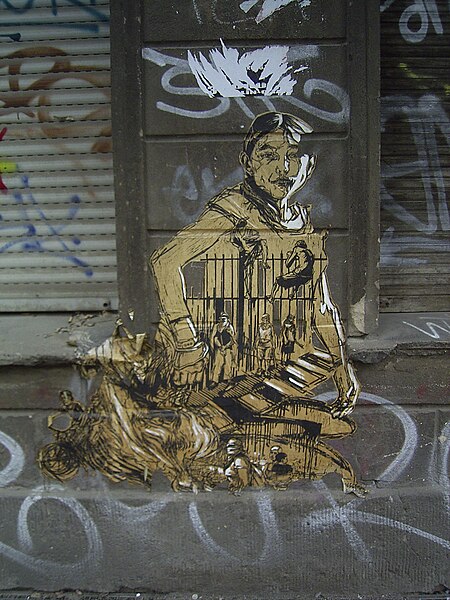
Swoon's art in Berlin. Wheat-pasted paper and ink. Image courtesy of Wikipedia.
The celebrated street artist Swoon tends to absorb her surroundings and combines wheat-pasted stencils with Realism à la Courbet. She creates larger-than-life images that suggest a momentary vision of a remotely familiar friend or place.Recently, BrooklynStreetArt.com co-founders Jaime Rojo and Steven Harrington sat down with Swoon at her New York studio, amidst a crowd of assistants. The interview is lively, honest, insightful, and leaves the impression that a retrospective isn't the end of the line for Swoon's plans.