 |
| Mary Cassatt. Mother and Child. 1905. Image courtesy of the National Gallery of Art Collection online. |

Showing posts with label Maria Guzman. Show all posts
Showing posts with label Maria Guzman. Show all posts
From Cassatt to Woodman: Ideal Space
This week, I led a discussion in class about the feminine ideal, the American-born artist, Mary Cassatt, and the use of space as a metaphor for sexuality/gender roles. It was a rich conversation but I was surprised at how accepting the class was about the assigned role of domesticity to a specific gender (feminine). While considering the prevailing concepts of what feminine beauty looked like--and what it promised the viewer--we compared two images, Cassatt's Mother and Child and Kenyon Cox's Eclogue:
Cassatt's work is an Impressionist version of a popular theme of mother and child. While the usual religious symbolism was omitted, the implicit piety of motherhood still resonates. As a matter of formal analysis, we discussed the "feminine" distinction of inhabiting predominantly domestic spaces. In addition, we considered the use of contemporary, "real" women as a means of subtly challenging the historical infrastructure of the feminine ideal. Consider this while looking at Cox's Neoclassical version of his subjects.


Ellen Gallagher: An Ad for the Unspoken
Ellen Gallagher is an American-born, contemporary multimedia artist that speaks about our inner thoughts and the obscured details that push the less palatable down. Gallagher's works confront what we all eventually face: deep, nagging insecurity, broad and unknown danger around the corner, and disappointing interpersonal moments. A person's art work most certainly speaks about what they have decided to look at and, finally, let surface.
This past week, a humbling and insightful discussion led me to consider the process of repression. As an individual, what subject bothers me enough to work through it in visual form? Can I explain it? Does it have to wholly bother me or is there a space somewhere between curiosity and shame that elicits artistic response?
Gallagher's answer would be yes, and she would display her own self through her striking collaged imagery. The origins of Gallagher's works is highly accessible--they are what some might consider instructional "aids" to looking your best. Wig ads especially stand out to Gallagher, and she speaks about how she aims to "activate" characters in her painted, repeated figures. She also refers to our early imaginations of what it was to "be" a certain way, and how sometimes as adults, we (as artists and/or in our daily lives) can manage these recollections and create alternate narratives. Following are clips that exemplify her elegant and astute approach to visual culture.
I enjoy looking at a work of art that doesn't attempt to do it all at once--surely, the topic of sexuality, beauty, or race can overwhelm an artist with the best intentions. It can be rooted in the fear of being misread, too. Sometimes, when making art, a person can just hold back and work on something else that satiates their basic desire to speak but does not speak enough.
To relax, and to meditate upon the lines, the color, the balance--can be a calming exercise as good as a vibrant conversation. To view Gallagher's work is to acknowledge an artist's goal to examine an industry that was considered necessary and that required iconography of its own. Systems of iconography are created and recreated each day. What an important reminder for anyone who is unsure of where to begin in the seemingly endless maze that is the 21st century visual landscape. Perhaps it might help to just begin a conversation about these anxieties, and take it from there?
If you enjoy Gallagher, check out Kara Walker, whose bold silhouettes recreate the largely shameful history of the depiction of black women and men in American history. These two artists are just two of the many women who have sat down and considered the lack of sympathetic, realistic, and heroic imagery for women of color.
Recently, I began a list of stereotypes or hurtful images that I could recall about Mexican culture or Latinas. Immigration sprang up immediately, and was followed by the ever-present maid figure in pop culture. There was a lot to think about. I researched Latina artists working today, and could not find many at all--this is a space that also needs to be occupied and engaged by young or mature artists as well. Besides Ana Medieta, Isis Rodriguez, and Frida Kahlo, there is a similar lack of visibility for Latinas.
Again, acknowledgment and response sometimes feels like a tall order--and the fear of reinforcing negative stereotypes persists--but pushing these highly reflexive cultural details down would be a tragedy. Check out Walker's discussion about the occasional doubts in her own creative process:
If you are intrigued by Kara's work, read Seeing the Unspeakable: The Art of Kara Walker by Gwendolyn Dubois Shaw.
This past week, a humbling and insightful discussion led me to consider the process of repression. As an individual, what subject bothers me enough to work through it in visual form? Can I explain it? Does it have to wholly bother me or is there a space somewhere between curiosity and shame that elicits artistic response?
Gallagher's answer would be yes, and she would display her own self through her striking collaged imagery. The origins of Gallagher's works is highly accessible--they are what some might consider instructional "aids" to looking your best. Wig ads especially stand out to Gallagher, and she speaks about how she aims to "activate" characters in her painted, repeated figures. She also refers to our early imaginations of what it was to "be" a certain way, and how sometimes as adults, we (as artists and/or in our daily lives) can manage these recollections and create alternate narratives. Following are clips that exemplify her elegant and astute approach to visual culture.
I enjoy looking at a work of art that doesn't attempt to do it all at once--surely, the topic of sexuality, beauty, or race can overwhelm an artist with the best intentions. It can be rooted in the fear of being misread, too. Sometimes, when making art, a person can just hold back and work on something else that satiates their basic desire to speak but does not speak enough.
To relax, and to meditate upon the lines, the color, the balance--can be a calming exercise as good as a vibrant conversation. To view Gallagher's work is to acknowledge an artist's goal to examine an industry that was considered necessary and that required iconography of its own. Systems of iconography are created and recreated each day. What an important reminder for anyone who is unsure of where to begin in the seemingly endless maze that is the 21st century visual landscape. Perhaps it might help to just begin a conversation about these anxieties, and take it from there?
If you enjoy Gallagher, check out Kara Walker, whose bold silhouettes recreate the largely shameful history of the depiction of black women and men in American history. These two artists are just two of the many women who have sat down and considered the lack of sympathetic, realistic, and heroic imagery for women of color.
Recently, I began a list of stereotypes or hurtful images that I could recall about Mexican culture or Latinas. Immigration sprang up immediately, and was followed by the ever-present maid figure in pop culture. There was a lot to think about. I researched Latina artists working today, and could not find many at all--this is a space that also needs to be occupied and engaged by young or mature artists as well. Besides Ana Medieta, Isis Rodriguez, and Frida Kahlo, there is a similar lack of visibility for Latinas.
Again, acknowledgment and response sometimes feels like a tall order--and the fear of reinforcing negative stereotypes persists--but pushing these highly reflexive cultural details down would be a tragedy. Check out Walker's discussion about the occasional doubts in her own creative process:
If you are intrigued by Kara's work, read Seeing the Unspeakable: The Art of Kara Walker by Gwendolyn Dubois Shaw.
Feminism & Collage: Wangechi Mutu
Over the past few months, developing a solid artistic technique and style have been personal goals of mine. One of my latest "turns" has involved using the early 20th century technique known as collage. Although the process, which literally means "to glue," is a hallmark of the modern art movement, its early forms in Art History are most often associated with Cubism, and with its primary figures--Pablo Picasso or Georges Braque.
Recently, a new friend suggested I check out the collage work of Wangechi Mutu. Originally born in Kenya and currently working in New York, Mutu's work expresses a regal approach to collage and distills the many nuances of identity as we understand it. As soon as I saw her work, I was reminded of Hannah Hoch's work and the concept of a "cultural self-portrait." Most of her subjects are female, and she has been quoted as saying "Females carry the marks, language and nuances of their culture more than the male. Anything that is desired or despised is always placed on the female body."
What I admired about this piece from Wangechi Mutu, Adult Female Sexual Organs, is that it is a reexamination of imagery in pop culture while at the same time calling up early "modern" imagery that distorted race, sexual, and values in the public realm. In fact, the image above is a multimedia collage that was superimposed upon medical illustration paper. What does that suggest as a point of departure?
A lot. Especially when the connection is made to African culture. Does anyone recall the unfortunately recent repatriation of the bodily remains of Sarah Baartman, better known as the colonialist oddity, "Hottentot Venus"?
These early pseudoscientific documents prescribed animalistic features or drives to women of color. They were accepted as guidelines for understanding unfamiliar body types, skin color, and whole cultures. Many of the stereotypes still influence popular belief systems, and are actively informing social interactions.
Contemporary artists before Mutu have examined this idea, and have taken on a performance-based approach to dispelling the absolutist beliefs about womens' identities. From Carrie Mae Weems to Grace Jones, there is much to discuss and see about this complex visual history.
Recently, a new friend suggested I check out the collage work of Wangechi Mutu. Originally born in Kenya and currently working in New York, Mutu's work expresses a regal approach to collage and distills the many nuances of identity as we understand it. As soon as I saw her work, I was reminded of Hannah Hoch's work and the concept of a "cultural self-portrait." Most of her subjects are female, and she has been quoted as saying "Females carry the marks, language and nuances of their culture more than the male. Anything that is desired or despised is always placed on the female body."
 |
| Wangechi Mutu. Adult Female Sexual Organs. 2005. Image courtesy of Saatchi Gallery Online. |
A lot. Especially when the connection is made to African culture. Does anyone recall the unfortunately recent repatriation of the bodily remains of Sarah Baartman, better known as the colonialist oddity, "Hottentot Venus"?
These early pseudoscientific documents prescribed animalistic features or drives to women of color. They were accepted as guidelines for understanding unfamiliar body types, skin color, and whole cultures. Many of the stereotypes still influence popular belief systems, and are actively informing social interactions.
Contemporary artists before Mutu have examined this idea, and have taken on a performance-based approach to dispelling the absolutist beliefs about womens' identities. From Carrie Mae Weems to Grace Jones, there is much to discuss and see about this complex visual history.
Intimacy Issues in Popular Culture and Art
 Cover of Amy Winehouse
Last weekend, a good friend called me and shared the unfortunate news that one of the more troubled entertainers in recent pop history, British singer Amy Winehouse, had passed away. While we considered the more obvious causes for her death, there were more deeply rooted issues that we drew out of such sad circumstances. Issues such as eating disorders, beauty image, and public image were matters that provoked a very compassionate discussion that reminded us to be thankful for each others' support.
It isn't easy for women, in the UK, the United States, or other countries, to balance their personal expression with the barrage of public standards that seem to fog up our concepts of artists, women, and culture altogether. Ann Powers addressed the unforgiving nature of pop celebritydom in this compassionate article via NPR. This particular passage reminded me of the creative tensions that can overwhelm people in their lives, and in shaping their creativity:
She seemed locked in a battle with the media — her observers both fretted over her and demonized her, and she responded with self-damaging defiance...Women's suffering has often inspired admiration from audiences whose embrace of their tragic heroine can seem like equal parts sympathy and sadism.Just a few weeks ago, I encountered an artist that I had not been aware of before. American artist Laurel Nakadate's work sort of bothered me at first glance. When I read more about her in this Economist article, I realized that she was grappling with the same (very public) issues that follow many people home--just as she does in her performances. The summation of Nakadate's early works illustrates her tendency to examine the intense voyeurism that many direct at women in general while framing it in her less seductive perspective. J.S. explained her technique as follows:
For several years she made videos featuring lonely older men who started conversations with her in grocery stores and parking lots; she would agree to go home with them as long as they allowed her to film what happened, which would usually turn out to be a scenario of her choosing. In some cases this meant a pretend birthday party (we see the man eating a slice of cake and then singing to her) or a pretend music video (we watch her dance to “Oops, I Did It Again”, Britney Spears’s paean to inadvertent seduction).Why Britney Spears? Why not? Her work is the epitome of public meets private image, and the damage that it can evoke over time. Was this Nakadate's attempt to weave a sense of morality to the fantasy-breaking videos and comment on the mirage of celebritydom? Perhaps, and it's worth contemplating.

Gender Law + Women in 21st Century Art History
My Bed by Tracey Emin. Image via WikipediaI recently started working for the Alameda County Public Defender's Office, and it rules. The people are down-to-earth, the work is intellectually stimulating, and it's a diverse work environment--all of these qualities bear much value to me in other areas of life, including Art History. The last thing I want is to ignore underrepresented social groups or to encourage exclusivity to anyone that wants to voice their issues. Where do Art History and Law "meet"?
While I admire artists--many of them women who have enhanced Art History through the advancements presented in the 21st century understanding of art's contribution to society--I often wonder how easy it is to slip into a coded language that does not allow the public to "see" themselves. It's a problem that emerges in legal matters as well; legal practice is conditional upon the need to defend individuals/groups who do not have the resources or historical support that others do. In this way, it is always a two-sided process. Similarly, Art History provides viewers with an opportunity to adopt (or reject) a "case" for a subject.
I thought about this, and immediately considered the linguistic intersection that I became familiar with a few years back; it was a definition that brought the cultural enforcement of gender to my attention, in a way that I had not ever considered--gender law profoundly changed how I perceived life and art in general. In addition, the legal community has not overlooked the necessity for specific attention to inequalites that are created as a result of gender difference and stereotyping.
How do artists contend with this issue? Dina Felluga put it best when she related the social construct of gender to an established construction, which renders it unnatural:Gender, according to Butler, is by no means tied to material bodily facts but is solely and completely a social construction, a fiction, one that, therefore, is open to change and contestation...Gender is, thus, a construction that regularly conceals its genesis" ("Performative" 273). That genesis is not corporeal but performative (see next module), so that the body becomes its gender only "through a series of acts which are renewed, revised, and consolidated through time" ("Performative" 274). By illustrating the artificial, conventional, and historical nature of gender construction, Butler attempts to critique the assumptions of normative heterosexuality: those punitive rules (social, familial, and legal) that force us to conform to hegemonic, heterosexual standards for identity.Awhile back, I wrote about Tracey Emin's work, and her role as an artist whom challenges gendered understandings of everyday actions. I recently came across another article (via Art in America) that directly addressed how she examined gender through its art historical tropes. The article briefly noted a genre, Minimalism, which tends to be observed as "empty" in comparison to more readily obvious content that reads as masculine or feminine iconography. Ossian Ward noted that:co-opted an industrial, masculine material generally associated with Minimal and Conceptual practitioners in America. Those neons hardly convey anything as specific as the bleeding-heart narrative of an oversexed, half-British, half-Turkish-Cypriot female artist from a small seaside town in southern England.I don't know what to think about that last sentence. If you ever read Anna Chave's illuminating discussion, titled "Minimalism and the Rhetoric of Power," about the hypermasculine subtexts of Minimalist art, it's clear that there's a gendered reading happening in that analysis. Gender (art) law strikes again!
What do you think about this analysis? Emin herself is not averse to discussing her art in terms of sex but that is quite different from discussing her work in terms of gender. Would you say that she represents herself well as a female artist? Should she be considering gendered language? As you can see, she's a favorite of mine, and I think that she incites reactions that expose the complexity of Art History's fairly repressed depiction of women, gender, and sex. Please leave your thoughts below!


Art and Citizenship
 Image via WikipediaLast week, President Obama made a trip to Ireland, and it was described in terms of finding his "roots." I watched a video in which he was described as a "rockstar," and felt the immense anticipation and pride that the audience (and the Obamas) felt that day.
To stand in a space and consider your roots and your legacy can be a joyous occasion. Art can also facilitate the connection between one's personal identity and their cultural heritage, and may reveal paths to a greater understanding beyond monolithic depictions of race and ethnicity. (Even Obama had to confront such misunderstandings recently when he presented his birth certificate to the public, finally putting the questioning of his citizenship to rest.)
I wonder, "How do art and citizenship intersect?" The first image that springs to mind is that of Peter Paul Rubens' depictions of war--but why? First, he was quite fascinated by the topic of war, as explained in this succinct Guardian UK article. This seems a timely thought since it was just Memorial Day weekend, too. I think that the reason that Rubens' works stand out to me has to do with the fleshy women that stood for national vulnerabilities, such as family (losing a member of family to war is a common tragedy), life in general (the ability to produce life), and on a more symbolic level, one's "land." Here's the image of the Allegory of the Outbreak of War:
![[Rubens,+Allegory+of+the+Outbreak+of+War.JPG]](https://blogger.googleusercontent.com/img/b/R29vZ2xl/AVvXsEj0ROCR-f9Wd7-v4JpcbhfJ7ExtQfkg_A2hENQrouZAH8C21LvDZk7Gl0QocMCtacTji5BzceIQTBhWhV2axfLG39UjQIrcL4ymIDOwtEewKmUK03feUrvg4NvrgiEdhvSu2dVvPnirAbQ/s640/Rubens,%2BAllegory%2Bof%2Bthe%2BOutbreak%2Bof%2BWar.JPG)
An artist that honored history and our contemporary understanding of war and national identity is Maya Lin. She designed the internationally recognized Vietnam Memorial monument (shown above). Considering the subject matter, it was considered a controversial work because of its design. The symbols she used were not in keeping with the more traditional symbols of American citizenship, such flags or images of the soldiers who were in the Vietnam War.
There are other works, such as Picasso's Guernica, in which women played a major role in either the symbolic content or the creation of the works. Which spring to mind? How do they address citizenship and a nation's identity?

Loving Picasso?
 Image via WikipediaThe current issue of ARTnews includes an article that reframes Picasso, as contemporary artists understand his work. Anyone who's seen a few knows that he likes to paint women, many of which appear to be disfigured and reimagined. What emerges when the standards of art-making have been further replicated and challenged over time? ARTnews' writer Ann Landi posed these questions:
But what about contemporary artists—the young and those in midcareer? Does Picasso still cast any sort of spell, almost 40 years after his death?Good questions! As an undergraduate student, the myth of Picasso became solidified through an unexpected source -- Fernande Olivier, one of his early (cough) lovers (I never use that word but it seems most appropriate in this context). Her relationship with Picasso was vividly illustrated, in her own words, throughout her journals. Loving Picasso: The Private Journal of Fernande Olivier is totally worth a read. After the demise of their relationship, of course, Picasso's Fernande Olivier's portraits ceased.
Earth Day & International Mother Earth Day--What's the Difference?
Did you know that Earth Day is also known as "International Mother Earth Day"? In addition, Mother Earth's birthday is being tied to important environmental discussions at the UN. According to Huffington Post contributor Bron Taylor, the 2009 decision to update the April 22nd holiday's moniker to "International Mother Earth Day" is a result of a South American reverence for nature (most notably, Bolivia's legal approach to environmental/spiritual practices).
Gender Coding via Drag in Art History
The first artist that springs to mind is Cindy Sherman, a celebrated American photographer who has maintained herself as both creator and subject in her large body of work. Here's one of the more well-known images, called Untitled (1981).
 | |||||||||||||||||||||||||
| Image courtesy of Metro Pictures |
Mirror, Mirror: On the Evolution of Women in Art History
This past week, my students explored the early to High Renaissance in class. We observed leaps and bounds in the role of the artist, the importance of humanism, and the innovations in formal techniques. Certain images kept popping up as signs of the times -- The Mona Lisa and the Arnolfini Wedding were most outstanding in terms of their reactions. Mona Lisa's daring eye contact and the presence of the mirror in the Arnolfini Wedding both pointed to a newfound reliance on the eye as a valued tool for understanding the world around us. During this period, man was the measure of all things, thanks to humanism.
Following are the famous images of mystery and enduring commitment:
 Arnolfini Wedding via Wikipedia
When students looked at these images, they marveled at the convincing illusionist techniques, and the absence of the artist in compositions. No one asked about the circumstances of the women in the paintings. Some found interesting articles about how da Vinci may have conceived his famous portrait from a self-portrait. Well, it's possible. And, it's not the first example of drag in Art History -- we can go back as far as ancient Egypt, when Queen Hatshepsut became pharoah. She took over the throne after the death of her pharoah husband Thutmose II, and donned the traditional masculine garb in accordance.
Following are the famous images of mystery and enduring commitment:
 Arnolfini Wedding via Wikipedia
When students looked at these images, they marveled at the convincing illusionist techniques, and the absence of the artist in compositions. No one asked about the circumstances of the women in the paintings. Some found interesting articles about how da Vinci may have conceived his famous portrait from a self-portrait. Well, it's possible. And, it's not the first example of drag in Art History -- we can go back as far as ancient Egypt, when Queen Hatshepsut became pharoah. She took over the throne after the death of her pharoah husband Thutmose II, and donned the traditional masculine garb in accordance.
Dear Planned Parenthood: Sexuality & Reproduction in Art
Lately, the arts and reproductive rights have been on my mind, which is not surprising by any means since both these topics are on the tips of many tongues. Whether it's Obama's plan to reduce arts funding or Planned Parenthood's recent setback, we've got a lot of advocating to do about their importance.
For example, view the video of Congresswoman Jackie Speier's reaction to a New Jersey representative's attempt to shame women who've had abortions. Sharing her abortion story truly took a great amount of bravery, and even more sensibility than what we've been observing lately regarding reproductive rights. As noted in the Mother Jones article, there is no question about what lies at the heart of the matter:
It's a similar story in Art History, where the language is pared down to a few canonical "documents" of culture. Take a moment to search your memory for art works and performances that display (and furthermore, celebrate) female sexuality.
I thought of a few: whether it's the subversive animation that brought us Bettie Boop, Tracey Emin's sensitive installation about intimacy, Everyone I Have Ever Slept With (1963-1995), Renee Cox's Yo Mama series, or Frida Kahlo's painting Henry Ford Hospital, the subject matter allows viewers to contemplate childbirth, loss, and the very public nature of womens' bodies.
Each of these women attached personal symbolism to their experiences, and this is no different from what we do in our daily lives. What I find most interesting about Henry Ford Hospital and Everyone I Have Ever Slept With (1963-1995), is that they do what Speier did -- they contribute to defending a platform for a larger community of women in similar positions.
When I am shocked by the ultimate ignorance of "leaders," it's always comforting to look at these art works and remember that you can't stifle imagination at its best.
For example, view the video of Congresswoman Jackie Speier's reaction to a New Jersey representative's attempt to shame women who've had abortions. Sharing her abortion story truly took a great amount of bravery, and even more sensibility than what we've been observing lately regarding reproductive rights. As noted in the Mother Jones article, there is no question about what lies at the heart of the matter:
Critics of the funding contend that because money is fungible, these dollars are, in effect, paying for abortion services.Moralizing rhetoric is rampant these days. In addition, opinions about sexuality have become confused with guidelines for reproductive rights.
It's a similar story in Art History, where the language is pared down to a few canonical "documents" of culture. Take a moment to search your memory for art works and performances that display (and furthermore, celebrate) female sexuality.
I thought of a few: whether it's the subversive animation that brought us Bettie Boop, Tracey Emin's sensitive installation about intimacy, Everyone I Have Ever Slept With (1963-1995), Renee Cox's Yo Mama series, or Frida Kahlo's painting Henry Ford Hospital, the subject matter allows viewers to contemplate childbirth, loss, and the very public nature of womens' bodies.
 |
| Frida Kahlo. Henry Ford Gallery. 1932. Oil on metal. Image via Olga's Gallery. |
Each of these women attached personal symbolism to their experiences, and this is no different from what we do in our daily lives. What I find most interesting about Henry Ford Hospital and Everyone I Have Ever Slept With (1963-1995), is that they do what Speier did -- they contribute to defending a platform for a larger community of women in similar positions.
When I am shocked by the ultimate ignorance of "leaders," it's always comforting to look at these art works and remember that you can't stifle imagination at its best.
Mujeres Muralistas or How I "Got Into" College
 |
| A Tribute to the Mujeres Muralistas in the Mission Distroct, via Flickr/Franco Folini |
During one of the early class sessions, my instructor was discussing his early career and passion for mural painting. He was so enamored with becoming a working artist that he aggressively pursued noted Mexican mural artist David Alfaro Siqueiros until he was able to work as his apprentice. He also talked about his visits to several universities in Mexico; during this part of the discussion, he revealed a longstanding cultural bias about women, the arts, and education -- that they do not belong together. The instructor looked me square in the eyes, and said, "You'll appreciate this story."
Google's Art Historical Turn: Art Project
I'm excited -- in addition to having access to countless databases, such as JSTOR, for online teaching purposes, Google has launched a virtual Grand Tour of museums around the world. As an art historian and artist, the first thoughts that arose were along the lines of identity politics -- will this Art Project fail in terms of the representation of women, for instance? How soon will I see Sylvia Sleigh's images or a comprehensive section that includes Black or Latina communities? How will ephemeral or larger-than-usual scale art be represented? I'd love to see work by recently deceased artist, Jeanne-Claude, and her longtime partner, Christo!
Here's a fun and subversive painting by Sleigh, which puts Orientalist and sexist visual text through the wringer:
 Image via Wikipedia
Here's a fun and subversive painting by Sleigh, which puts Orientalist and sexist visual text through the wringer:
 Image via Wikipedia
Swoon's Global Sculptures
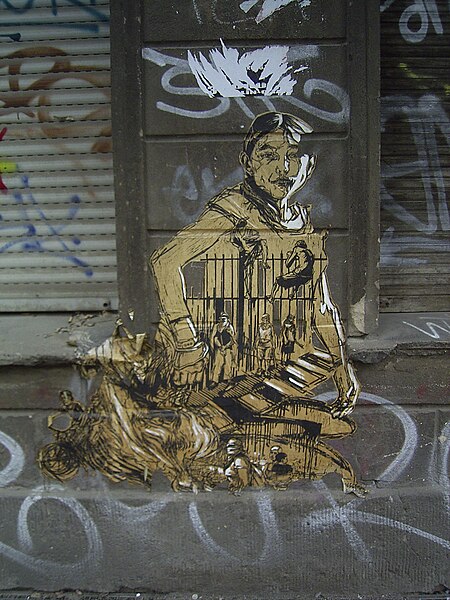 |
| Swoon's art in Berlin. Wheat-pasted paper and ink. Image courtesy of Wikipedia. |
Subscribe to:
Posts (Atom)